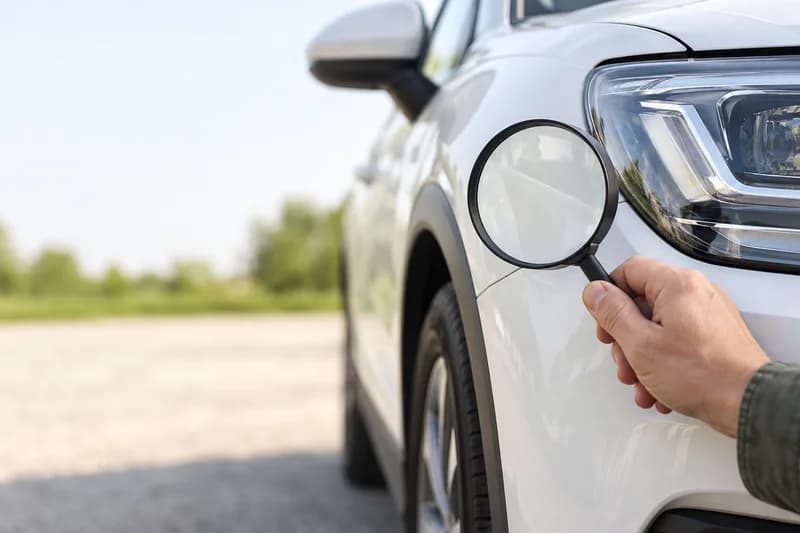

Inspect a used car in three stages: check its identity and records, observe its condition and behavior, then pay an independent mechanic to investigate anything you cannot verify. A checklist organizes evidence; it does not certify safety. Agree on inspection access before paying a deposit or committing to the purchase.
In this guide · 7 steps
Arrange the inspection before the appointment
Ask for the VIN, current mileage, service records, title status, and permission for an independent inspection before you travel. Confirm which shop will inspect the car, who pays, and how it will get there. Choose a shop familiar with that powertrain. A general inspection may need a separate specialist for a high-voltage battery, modified vehicle, or suspected structural repair.
Schedule daylight and enough time to look without rushing. Ask the seller to leave the engine cold if practical; a pre-warmed engine changes what you can observe at startup. Bring a flashlight, a phone for permitted photos, and your written questions. Avoid inspecting on a roadside or crawling beneath an unsupported vehicle. You do not need to perform repairs to be a careful buyer.
Set a simple boundary in advance: an unexplained identity discrepancy, refusal of a reasonable inspection, or unresolved safety concern means you pause. That boundary is easier to maintain before you have spent hours negotiating or become attached to a particular color.
Match the car to the paperwork
Read the VIN on the vehicle and compare it with the title, listing, service invoices, and history report. Record the mileage you actually see. A dealer stock number is not a substitute for a VIN. Ask the seller to explain mismatches and verify the explanation through the issuing organization before proceeding.
For a dealer sale, read the Buyers Guide. The FTC explains that this document identifies warranty coverage or an as-is sale and that an independent mechanical inspection remains useful even when the car is described as certified. Get any promised repairs in writing. A sales conversation and a completed repair invoice are different kinds of evidence.
Create a short missing-information list: a second key, a recent maintenance invoice, proof that a lien can be released, or the terms of a service contract. A missing service receipt does not prove neglect, but it leaves uncertainty. Price and plan around what you can verify instead of assuming every undocumented job was done.
Walk around, then inspect the cabin
View the body from several angles and compare adjacent panels. Note inconsistent paint, uneven gaps, cracked lamps, damaged glass, and visible corrosion. These observations are prompts for the mechanic, not a remote diagnosis of a crash. Open doors, the trunk, and the hood with the seller present. Check that latches and the features you will use operate consistently.
The FTC identifies water staining, silt, unusual odors, and moisture in lights as possible flood clues. Record clusters of clues rather than treating one smell as proof. A heavily cleaned interior cannot establish whether hidden wiring or restraint components were exposed to water. Suspected flood damage warrants a specialist assessment, and walking away is reasonable when the history remains unclear.
Try the seat adjustments, seat belts, windows, locks, lights, heating, air conditioning, and rear visibility. Fit your normal passengers or child seat if possible. An uncomfortable driving position is a purchase problem even when the car is mechanically sound. Photograph findings with permission so you can distinguish this vehicle from the next one you see.
Put the guidance into practice.
Use your own numbers to explore the next step.
Used car inspection checklist Used car price negotiation calculatorLet the mechanic measure what matters
A visible tire check can reveal cuts, bulges, or uneven wear, but ask the shop to measure tread and assess tire condition and age. Check the vehicle placard for specified sizes and pressure rather than using a tire sidewall maximum as the operating target. NHTSA emphasizes that maintenance and tire condition matter to safety.
Ask the inspector to document brake condition, leaks, suspension wear, corrosion, cooling-system concerns, and signs of previous repair. Request a scan and an explanation of any diagnostic findings. A code identifies a system or condition to investigate; it is not automatically a quote for a particular replacement part. Recent code clearing or incomplete readiness information also needs context.
For a hybrid or EV, ask exactly what battery assessment the inspection includes and what it cannot establish. A dashboard range estimate is not a battery health certificate. Never open high-voltage components yourself. Obtain model-specific professional advice when range, charging behavior, or battery history is central to your decision.
Take a normal, lawful test drive
Agree on a route that includes the kind of driving you do, subject to insurance arrangements and local rules. Start with normal controls: startup behavior, warning lights, steering feel, visibility, and parking. Then observe acceleration, gear changes, braking, vibration, and noises at legal speeds. Keep your attention on driving and have a passenger take notes if needed.
Do not provoke a skid, disable safety equipment, or attempt an emergency maneuver to test the car. Stop if you observe a serious warning, smoke, overheating, or braking problem. Describe symptoms precisely to the mechanic: a vibration at a certain speed is more useful than saying the car feels bad.
Check the VIN through NHTSA recalls and read any manufacturer interim instructions. An open recall needs a repair plan; a zero-result search does not establish overall mechanical safety. Ask the manufacturer about a recall that appears in other records but not in the lookup.
Turn findings into a repair budget
Have the inspector separate immediate safety work, scheduled maintenance, comfort repairs, and items to monitor. Ask for written estimates with labor, parts, and uncertainty. A possible transmission problem with no diagnosis should not be converted into a confident small discount. Decide whether the uncertainty itself exceeds what you can take on.
For an illustrative purchase, assume the vehicle costs $15,500 and the inspection identifies $650 of tires and $450 of brake work. Your initial outlay becomes $16,600 before tax, registration, inspection fees, and other costs. If you also want a $1,000 repair reserve, you need access to $17,600 plus those other charges. These are example amounts, not typical repair prices.
Use the inspection checklist to preserve findings and the negotiation calculator to explore an offer. Do not subtract the same defect twice if your comparison price already reflects that condition. A negotiated discount only helps when you can fund and arrange the actual repair.
Make the decision and keep the evidence
Compare the inspected vehicle with your alternatives using total cost, suitability, and unresolved risk. Keep the inspection report, quote, warranty terms, and promised-work agreement together. Before collection, confirm promised work was completed and inspect the car again for changes in condition or mileage.
A checklist with every box marked does not predict the next failure or replace a professional assessment. Its value is that it makes unanswered questions visible. Use the ownership calculator to add insurance, fuel, maintenance, and financing before deciding that the purchase price fits your budget.
If you decline the car, save the useful lessons and move on. The money spent on an inspection can still have served its purpose by identifying a purchase that does not match your needs.
Sources and further reading
- FTC: Buying a used car from a dealer ↗
- FTC: Flood-damaged car warning signs ↗
- NHTSA: Check for recalls and lookup limitations ↗
- NHTSA: Tire safety and maintenance ↗
Examples are hypothetical unless explicitly stated. Prepared with AI assistance and source research; no independent professional review is claimed. Verify current rules and contract terms for your situation. Read the full disclaimer.
Save the guide, collect the missing evidence, and revisit your numbers before committing.