Key takeaways
- Set a Realistic Used Car Budget
- Research Reliable Used Cars
- Compare Used Car Market Prices
- Verify the Vehicle Identification Number and Ownership
- Check Accident, Flood, and Title History
To buy a used car safely, set a realistic budget, research suitable models, verify ownership and vehicle history, inspect the car, arrange an independent mechanical inspection, compare prices, and review every document before paying. These checks reduce risk but cannot guarantee future reliability.
Jump to a section1 / 18
Quick Answer: How Do You Buy a Used Car Safely?
Follow these 12 steps:
A vehicle that looks attractive in photographs may still have hidden mechanical or documentation problems. Careful research helps reduce these risks.
- Determine your total vehicle budget.
- Research reliable used cars within your price range.
- Compare market prices for similar vehicles.
- Verify ownership and vehicle history.
- Check accident, flood, and title records.
- Inspect the vehicle's exterior and interior.
- Examine the engine, tires, brakes, and suspension.
- Take a comprehensive test drive.
- Arrange an independent mechanic's inspection.
- Calculate financing and ownership expenses.
- Negotiate using market evidence.
- Verify the paperwork and complete the transaction securely.
Which guide should you read next?
Use this page to plan the full purchase. Follow the detailed guides below for your budget, mileage, inspection, seller verification, and timing questions.
Set a Realistic Used Car Budget
Before searching for a vehicle, determine how much you can comfortably spend.
Your budget should cover more than the advertised purchase price.
Consider:
- Vehicle purchase price
- Sales tax and registration charges
- Insurance premiums
- Loan interest and financing fees
- Fuel or electricity costs
- Routine maintenance
- Tires and unexpected repairs
Example: Used Car Purchase Budget
Suppose you're considering a used vehicle priced at $15,000.
These are hypothetical planning amounts, not actual quotes. Local taxes, fees, and repair expenses vary.
Buying tip: Keep a separate emergency maintenance reserve rather than spending your entire available budget on the purchase.
Use the Car Affordability Calculator to help evaluate your budget.
| Expense | Illustrative amount |
|---|---|
| Vehicle price | $15,000 |
| Taxes and registration | $1,200 |
| Initial maintenance | $500 |
| Inspection | $150 |
| Estimated initial cost | $16,850 |
Put the guidance into practice.
Use your own numbers to explore the next step.
Car affordability calculator Used car inspection checklistResearch Reliable Used Cars
The best used car isn't necessarily the cheapest vehicle available.
Look for a model that meets your transportation needs while offering reasonable maintenance costs, suitable safety equipment, and a documented service history.
What makes a good used car?
Consider these factors:
Reliability: Research known mechanical problems for the specific model, engine, transmission, and production year.
Fuel efficiency: Compare estimated fuel consumption based on your driving habits.
Maintenance costs: Check the availability and prices of replacement parts.
Safety: Review relevant crash-test results and available safety features.
Resale value: Consider how the vehicle may depreciate during ownership.
Practicality: Choose suitable passenger space, cargo capacity, and driving characteristics.
Used car types to consider
Always research the exact vehicle rather than assuming every model from a particular brand has the same reliability.
| Vehicle type | Common advantages | Potential drawbacks |
|---|---|---|
| Compact sedan | Practical commuting, often lower fuel costs | Limited cargo capacity |
| Hatchback | Flexible cargo space | Less room than larger vehicles |
| SUV | Passenger space and versatility | Potentially higher fuel and tire costs |
| Hybrid | Lower fuel use in suitable driving conditions | Battery condition requires attention |
| Electric car | Lower routine drivetrain maintenance | Charging access and battery health matter |
| Pickup truck | Towing and carrying capability | Higher operating costs in some configurations |
Compare Used Car Market Prices
Before contacting a seller, compare several vehicles with similar specifications.
Look for listings with matching:
A vehicle advertised significantly below comparable listings deserves additional investigation.
- Model year and trim level
- Engine and transmission
- Mileage
- Condition and accident history
- Geographic market
- Service history
- Optional equipment
How do you know if a used car is overpriced?
Compare the asking price against similar local vehicles, then account for mileage, condition, service records, accident history, and necessary repairs.
For example, if comparable cars are advertised between $14,000 and $16,000, a $17,500 asking price may require justification through condition, equipment, or other measurable differences.
Remember that advertised prices are not necessarily final transaction prices.
Use a Car Value Estimate as an additional planning reference, not a guaranteed appraisal.
Verify the Vehicle Identification Number and Ownership
A vehicle identification number (VIN) helps identify a specific vehicle and investigate available history records.
For many modern vehicles, particularly in the United States, the VIN contains 17 characters.
How to check a used car's VIN
A mismatch between vehicle identifiers and official documentation is a serious warning sign.
In markets such as Pakistan, verification procedures differ. Check the relevant provincial vehicle registration authority, chassis and engine numbers, and available ownership records.
- Locate the VIN on the vehicle.
- Compare it with registration and ownership documents.
- Review available title and vehicle-history records.
- Investigate any inconsistencies.
- Confirm the seller has the legal authority to transfer ownership.
Check Accident, Flood, and Title History
A vehicle history report can provide useful information about previous events, but it cannot guarantee that a vehicle is free of problems.
Depending on the country and data provider, available records may include:
- Reported accidents
- Ownership changes
- Salvage or rebuilt title status
- Recorded mileage
- Insurance loss information
- Theft records
- Available service history
Can a used car have a clean history report but still be damaged?
Yes. A clean vehicle history report does not prove that a car has never been damaged.
Some accidents, repairs, and maintenance activities may never appear in commercial databases.
Use history reports alongside a physical inspection and independent mechanic's assessment.
For additional guidance, read our Vehicle History Checking Guide.
Inspect the Used Car Before Buying
A physical inspection is one of the most important parts of purchasing a secondhand vehicle.
Inspect the car in daylight, ideally when the engine is cold.
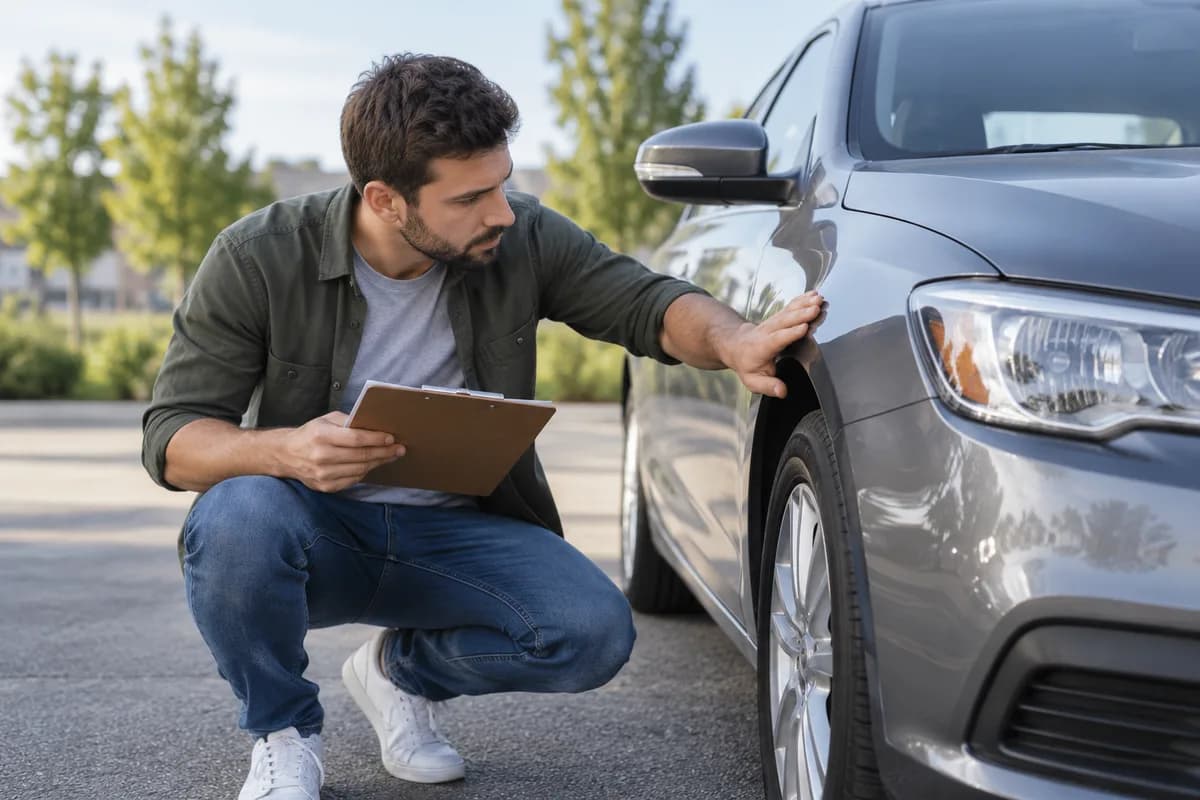
Exterior inspection checklist
- Look for inconsistent paint colors.
- Check panel gaps and body alignment.
- Inspect for rust and corrosion.
- Examine the windshield and windows.
- Check headlights and taillights.
- Inspect tire wear patterns.
- Look for evidence of previous structural repairs.
Interior inspection checklist
- Test air conditioning and heating.
- Check dashboard warning lights.
- Inspect seats and seatbelts.
- Test windows, locks, and mirrors.
- Look for water damage or unusual odors.
- Test the infotainment system.
- Examine general wear against the recorded mileage.
Engine inspection checklist
Do not open a hot cooling system or touch moving engine components.
Important: A visual inspection cannot replace a professional mechanical assessment.
Read our complete Used Car Inspection Guide for a more detailed process.
- Check for visible fluid leaks.
- Listen for unusual knocking or rattling.
- Examine accessible belts and hoses.
- Check fluid levels where appropriate.
- Look for signs of overheating.
- Observe the exhaust for unusual smoke.
Test Drive the Vehicle
A test drive helps reveal problems that may not be visible when a vehicle is parked.
Drive on suitable roads and, where legal and safe, include different speeds and driving conditions.
What should you check during a test drive?
Engine performance: The vehicle should accelerate smoothly without unexpected hesitation or abnormal noises.
Transmission: Gear changes should be appropriate for the transmission type, without excessive slipping, harsh engagement, or unusual delay.
Braking: Brakes should respond predictably without excessive vibration or pulling.
Steering: Watch for unusual looseness, vibration, or directional pulling.
Suspension: Listen for knocking noises over uneven surfaces.
Electronics: Confirm that relevant controls and features operate properly.
If a seller refuses a reasonable test drive or independent inspection, consider that a significant warning sign.
Arrange an Independent Mechanic's Inspection
A pre-purchase inspection is particularly valuable when buying an older or higher-mileage vehicle.
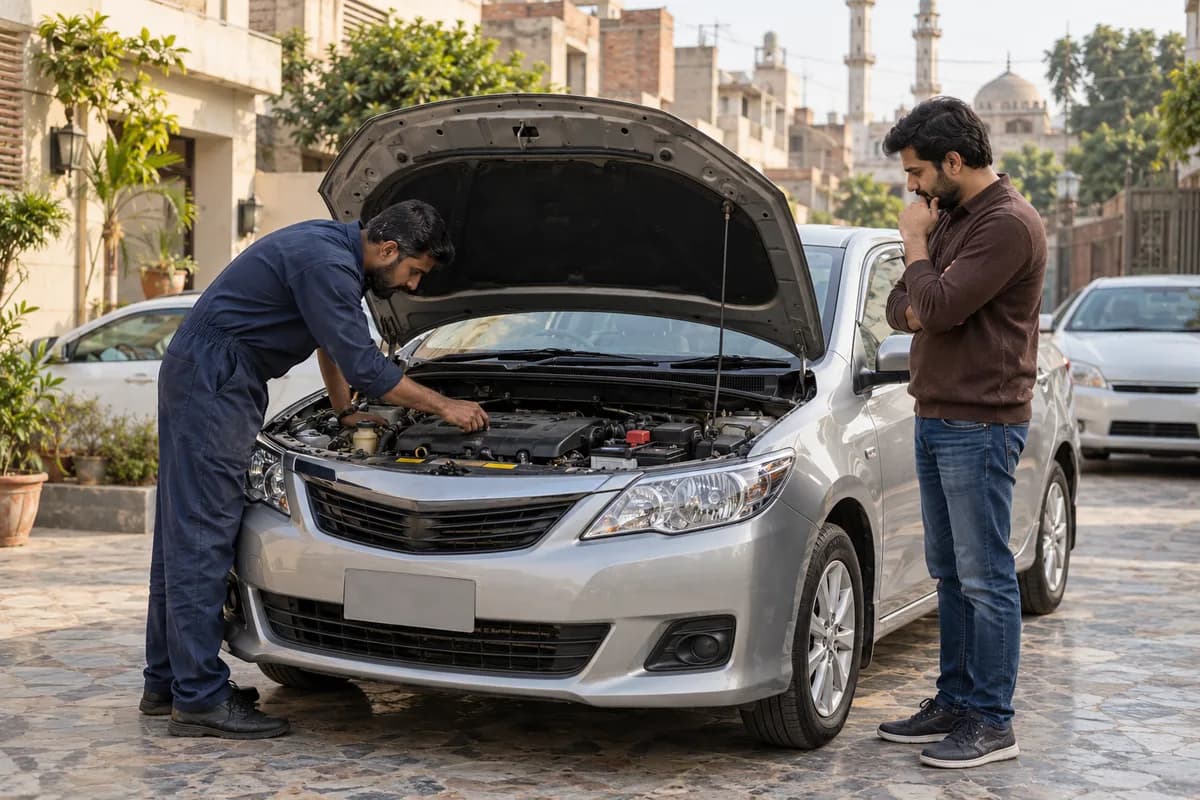
An independent mechanic may identify:
- Engine or transmission leaks
- Suspension wear
- Brake problems
- Structural repair evidence
- Diagnostic fault codes
- Cooling system problems
- Expensive maintenance requirements
Is a pre-purchase inspection worth it?
In most cases, yes. The inspection costs money upfront, but it may identify repairs that materially change the vehicle's value or make the purchase unsuitable.
Ask for a written report and repair estimates where possible.
If serious safety or structural concerns remain unresolved, be prepared to reject the vehicle.
Calculate the True Cost of Car Ownership
The purchase price is only one component of vehicle ownership.
A more complete budget includes depreciation, fuel, insurance, maintenance, registration, and financing costs.
Example: Annual Used Car Ownership Costs
This example excludes depreciation and financing interest. Actual costs depend on the vehicle, location, usage, and insurance profile.
When comparing cash purchases and financed purchases, distinguish financing cash flow from economic ownership costs to avoid counting principal repayment twice.
Explore the Cost of Ownership Calculator.
| Expense | Hypothetical annual cost |
|---|---|
| Fuel | $1,800 |
| Insurance | $1,400 |
| Maintenance and repairs | $900 |
| Registration and recurring taxes | $300 |
| Annual operating expenses | $4,400 |
Compare Used Car Financing Options
Financing allows buyers to spread the purchase cost across monthly payments, but borrowing increases the total amount paid.
Before accepting a loan, compare:
- Annual percentage rate (APR)
- Amount financed
- Loan term
- Monthly payment
- Total repayment amount
- Fees and optional products
- Early repayment conditions
Example: Used Car Loan Calculation
Suppose you finance $12,000 at a fixed annual interest rate of 8%, with monthly payments and no additional fees.
These figures are illustrative and rounded. They assume standard monthly amortization.
A longer term lowers the monthly payment but generally increases total interest when other loan conditions are equal.
Key takeaway: Compare total borrowing costs, not just monthly payments.
Use our Car Loan Calculator to model your financing scenario.
| Loan term | Approx. monthly payment | Approx. total interest |
|---|---|---|
| 36 months | $376 | $1,537 |
| 48 months | $293 | $2,062 |
| 60 months | $243 | $2,599 |
Negotiate the Used Car Price
Successful negotiation begins with evidence.
Research comparable vehicles and document any problems identified during inspection.
How to negotiate a used car price
- Identify a reasonable local market range.
- Obtain written repair estimates.
- Calculate your maximum affordable purchase price.
- Make an offer supported by the vehicle's condition.
- Request an itemized total purchase price.
- Be willing to walk away if the terms are unsuitable.
Used car negotiation example
Imagine a vehicle is advertised for $15,500.
Comparable listings suggest a value near $14,800, and an independent inspection identifies approximately $700 in repairs.
You could use those findings to justify a lower offer, while recognizing that the seller may disagree and comparable listing prices may not represent actual sale prices.
Avoid aggressive tactics or unsupported claims.
Read our Used Car Price Negotiation Guide.
Verify Paperwork Before Making Payment
Before completing a purchase, confirm that all required documents are authentic, consistent, and sufficient for a legal transfer.
Depending on your location, these may include:
- Ownership certificate or title
- Vehicle registration
- Seller identification
- Purchase agreement
- Lien or finance clearance
- Required inspection or emissions documentation
- Tax and transfer records
How to avoid used car buying scams
Be cautious when a seller:
Use a secure, traceable payment method and complete the required ownership transfer through the appropriate authority.
Do not assume a signed receipt alone establishes legal ownership.
- Refuses to provide ownership documents.
- Pressures you to pay immediately.
- Requests payment through unusual or irreversible methods.
- Provides inconsistent vehicle information.
- Prevents an independent inspection.
- Offers a price that seems unusually low without a credible explanation.
Common Used Car Buying Mistakes
Many expensive mistakes happen because buyers focus on the advertised price rather than the vehicle's overall condition and long-term cost.
Avoid these common problems:
The best protection is a consistent research and inspection process.
- Buying without checking ownership records
- Skipping the test drive
- Ignoring dashboard warning lights
- Failing to inspect for accident damage
- Accepting financing without comparing total costs
- Overlooking registration and insurance expenses
- Trusting a clean history report as definitive proof
- Paying before verifying transfer documentation
Frequently Asked Questions About Buying a Used Car
What is the first thing to check when buying a used car?
Start by confirming the vehicle's identity and ownership documentation. Then review available history records and inspect the vehicle's condition before making a financial commitment.
What mileage is too high for a used car?
There is no universal mileage limit. Maintenance history, driving conditions, age, vehicle design, and mechanical condition are more useful than mileage alone. A well-maintained higher-mileage car may be preferable to a poorly maintained lower-mileage example.
How old should a used car be?
There is no single ideal age. Compare depreciation, reliability, safety features, remaining warranty coverage, repair costs, and available budget. The best choice depends on the specific vehicle.
Is buying a used car from a dealership safer than buying privately?
Dealerships may offer additional consumer protections, financing options, or warranties, depending on local laws and contract terms. Private sellers may offer different prices or negotiation flexibility. Both require careful verification.
Can you buy a used car without a mechanic's inspection?
You can, but doing so increases the risk of missing mechanical problems. An independent pre-purchase inspection is strongly recommended, particularly for older vehicles or cars without comprehensive service records.
How much should you negotiate on a used car?
There is no fixed percentage. Base your offer on comparable prices, documented condition, necessary repairs, and your budget rather than assuming every seller has the same negotiation margin.
Should you pay cash or finance a used car?
Cash avoids borrowing interest but reduces available savings. Financing preserves some liquidity but creates repayment obligations and may increase the total purchase cost. Compare both options against your emergency savings and financial priorities.
How can you check if a used car has an open safety recall?
In the United States, use the official NHTSA recall lookup with the vehicle's VIN. Outside the United States, check the relevant manufacturer or national vehicle safety authority. Recall database coverage differs by market.
What is the biggest risk when buying a used car?
One of the most significant risks is purchasing a vehicle with undisclosed mechanical, structural, legal, or ownership problems. Combining documentation checks, independent inspections, and market research helps reduce this risk.
Is a cheaper used car always better value?
No. A lower purchase price can be offset by repairs, poor fuel economy, expensive insurance, or rapid depreciation. Compare the total expected cost of ownership rather than the advertised price alone.
Final Used Car Buying Checklist
Before completing your purchase, confirm that:
Marks stay on this page and clear on reload. They record your notes; they do not certify the vehicle’s condition.
Make a Smarter Used Car Decision
Buying a reliable used car requires more than finding an attractive listing.
The strongest purchase decisions combine research, financial planning, vehicle-history verification, mechanical inspection, and careful documentation.
At BuyUsedAutomobiles, our guides and calculators help you compare important costs and understand the decisions involved in buying, owning, and selling vehicles.
Start with our Car Loan Calculator, explore the Cost of Ownership Calculator, or browse our Used Car Buying Guides.
Research carefully. Compare confidently. Buy smarter.
Sources and further reading
- FTC: Buying a used car from a dealer ↗
- NHTSA: Safety recall lookup ↗
- DOJ: NMVTIS consumer vehicle history information ↗
Examples are hypothetical unless explicitly stated. Prepared with AI assistance and source research; no independent professional review is claimed. Verify current rules and contract terms for your situation. Read the full disclaimer.
Save the guide, collect the missing evidence, and revisit your numbers before committing.